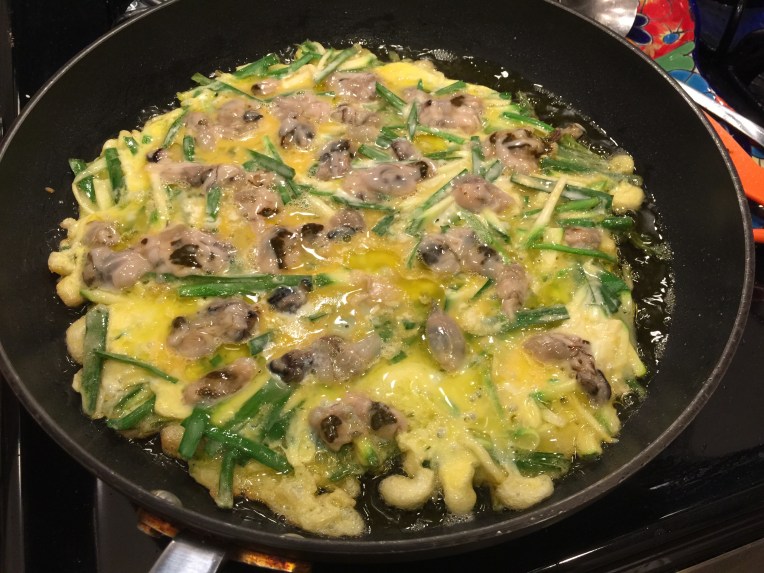
More vegetables please Mommy!!!! (Buchujeon)


Vodpod videos no longer available.

more about “More vegetables please Mommy!!!!“, posted with vodpod


I can’t believe it myself but you’re reading it right. My title says “more vegetables please Mommy!” My daughter is an addict! She loves this recipe so much she can’t get enough and will even ask for more and not leave anything for her Dad. 

This is Maangchi’s Korean Vegetable Pancake recipe called Buchujeon in Korean. You can see her recipe at her website but as always, I give my version a personal touch. 

Here’s what I do: 

INGREDIENTS: 

Small Korean Zucchini (or italian zucchini) 

5-8 Stalks of Green Onions 

1 Korean Chili (I use this because it’s not hot/spicy – good for kid-friendly recipes) 

1 Egg 

 A piece of small Carrot 

3 Garlic cloves 

Fresh Oysters (optional: or shrimp and try scallops) 

Chop and julienne the carrots and zucchini. Add in the thinly chopped green onions and korean chili. In a separate bowl, mix in 1/2 cup flour, salt and 2/3 cup water or sometimes I use a store-bought korean vegetable pancake mix and follow the package instructions. 

Chopped vegetables should be around 3 cups. Mix the vegetables with the batter and mix it up with your hands to spread evenly.Chop 3-6 pieces of fresh oysters and set aside. 

In a big heated non-stick pan, put some olive oil and spread the vegetable pancake mixture. Put your heat to medium. Top the raw side of the cooking pancake with fresh oysters and one beaten egg. Wait about 5-8 minutes before flipping the pancake. 

After 8 minutes, flip the pancake and add more olive oil (if needed) to make it crunchy (a cooking tip from Maangchi). Press the pancake down with a spatula and check once in a while to see if it’s getting cooked the way you want it to be. 

My secret dipping sauce that really makes my daughter eat this pancake a lot is a mixture of 1/4 cup rice vinegar, 2 tablespoon of light soy sauce and a pack of splenda. You can use sugar if you want but I don’t have that in my pantry 🙂 

Use other vegetables if you want to explore it! I’ve tried, sweet potato with green onions, chives and red peppers, I even tried bean sprouts with oysters as suggested by my husband. 

Enjoy and let me know about your version!

The Art of Miso Ramen

Vodpod videos no longer available. 

more about “The Art of Miso Ramen“, posted with vodpod


I wish I can make this everyday but I feel like it’s too much work even if it’s really simple.  Making a warm bowl of miso ramen is a lot of work for me just like many of my other favorite japanese food. Because of it’s precision process, sometimes having a bowl of this from a small authentic jap restaurant is better than making your own. Here, I will share how I made this beautiful work of art so you can try your own version too.

INGREDIENTS:

  • Fresh ramen noodles
  • Some pork belly
  • 4-5 cups water
  • 2-4 tablespoons miso paste (depending on taste and kind you like, I use white miso)
  • 2-4 teaspoons chili oil
  • 1/2 teaspoon hondashi
  • hard boiledeggs  and sweet corn kernels
  • Narutomaki(fish cake with pink swirl)
  • 1 stalk green onion (finely chopped)
  • 1 tablespoon white sesame seeds (pounded until fine)
  • Light soy sauce to taste (optional)
  • Seasoned laver/seaweed (cut into strips)

METHOD:

Bring water to boil with the cleaned whole piece of pork. Let it simmer for a while then remove the pork and skim remaining stock. Add in the miso paste, hondashi, eggs and sesame seeds. Bring the soup base to boil. Add in the chili oil and light soy sauce to taste (optional). Blanch the fresh noodles in a pot of boiling water until they are cooked. Rinse with cold water, drain and set aside. I rub the noodles with a little bit if vegetable oil to keep it moist. In a serving bowl, add the noodles then top with the hard-boiled egg, sliced pork, narutomaki, corn kernels and chopped green onions. Pour the miso soup base into the bowl and add the roasted seaweed to top then serve immediately. Look at my photo gallery to be inspired and get hungry!

Note: I added preserved bamboo shoots to my soup because my favorite bowl of ramen from a japanese ramen restaurant serves theirs with some.

Doyd’s Spicy Mackerel Stew


2 Medium size fresh Mackerel (cleaned and cut into 2-3 inch pieces, remove head)

1 Medium size Korean Radish cut into 2×1 inch cubes

1 whole medium Onion

3 stalks of Green Onion

2 Korean Hot Pepper

7-10 Dried Anchovies

2-3 cups of water (depending on how much sauce you want)

For the Spicy Sauce, mix the following into a bowl:

2 Tablespoons of  Red Pepper Paste

2 Tablespoons of Light soy sauce

2 Tablespoons of  Cooking Wine (I use Japanese cooking wine)

1 Tablespoon Red Pepper Powder (same one used to make kimchi)

2 Teaspoons of Sugar

5-7 cloves of minced Garlic

1/2 Teaspoon minced Ginger

In a ceramic pot, let the water boil with the dried anchovies and wait 5 minutes then remove the anchovies.  While the stock is boiling, add the radish.  On top of the radish, arrange the mackerel pieces.

Pour the sauce on top of the mackerel.  DO NOT MIX.  Let it boil until the soup is reduced.   Occasionally pour the stew’s broth over the fish and radish.

Add the onion, green onions and korean chili on top of the stew.  Continue to pour the broth of the stew on top of everything until the mackerel is well-cooked and the flavor has sipped into all the vegetables.

My husband and I love this dish a lot.  I do not cook mackerel before but now, I do.  I learned this recipe from a restaurant where I first tasted this stew.

Hope you all enjoy cooking your own version.  It’s really easy 🙂

Tasty, yummy and rich Spicy Mackerel Stew.

Spaghetti Rigatti with Broccoli-Pine Nut Pesto


broccoli pesto
Originally uploaded by doyd74

I got this recipe from a magazine but I changed it a little bit. I wanted to create a pasta dish that will be light, refreshing, delicious and healthy for my husband and daughter. I think I did the right thing because they both loved it!

When I read or watch about new recipes elsewhere, I try to make it my own by using local ingredients from my “pantry.” Most of the time I am lucky with the result but there are times I learn and realize that not all similar looking ingredients go well with others.

Here’s how to make one for yourself:

1/3 cup roasted pine nuts
1/2 pound broccoli cut into florets
3 garlic cloves (i added more because i love the garlicky smell)
1/3 cup plus 1 tablespoon extra-virgin olive oil
Pinch of crushed red pepper
1/3 cup grated pecorino or parmesan cheese, plus more for serving
salt and pepper
spaghetti rigatti

Roast the pine nuts on an ungreased non-stick pan until fragrant and lightly brown; let cool.

In a large pot of boiling salted water, cook the broccoli until tender and bright green. Drain well and wash with cool running water. Drain and squeeze out the excess water (I personally use a salad spinner for this!).

In a food processor, add the garlic, 1/3 cup of roasted pine nuts; pulse until coarsely chopped. Add the broccoli, olive oil and crushed pepper and process until everything is finely chopped. Add the cheese and pulse until combined. Season with salt and pepper. Put the pesto in a large bowl.

Cook your pasta until al dente and reserve a few tablespoons of pasta cooking water. Add the spaghetti rigatti to the pesto sauce, then stir in the reserved cooking water and toss until the pasta is well coated with the pesto sauce. Sprinkle with some more roasted pine nuts and some freshly grated parmesan cheese.

Kids will love this! Let them top their own plate with the nuts and cheese to make it fun!

my pot

On this blog, I will share a  wide variety of recipes of my own version.  I remember, started helping in the kitchen at the age of about 8, probably even younger, I just don’t remember exactly.  My mom let us help by slicing green beans and potatoes using a butter knife just to get the hang of being in the kitchen.  It was indirectly know that my kitchen skills were upgraded when I was allowed to hold a kitchen peeler and started working on peeling turnips for our mid-afternoon snack after playing with friends in our old childhood apartment in Loyola Heights, Katipunan.  Oh, I also do remember that when I am able to chop onions back then, that means I am truly a big kid and I am in control of what I’m doing 🙂  I still remember that feeling.  I was really excited about being able to help out in the kitchen.

Growing up with both parents working, my siblings and I learned specific chores at home.  We were given specific responsibilities and these became our training ground.  My home, my parents and my childhood was definitely my foundation and it helped me learn to love what I have and appreciate the small things I own.